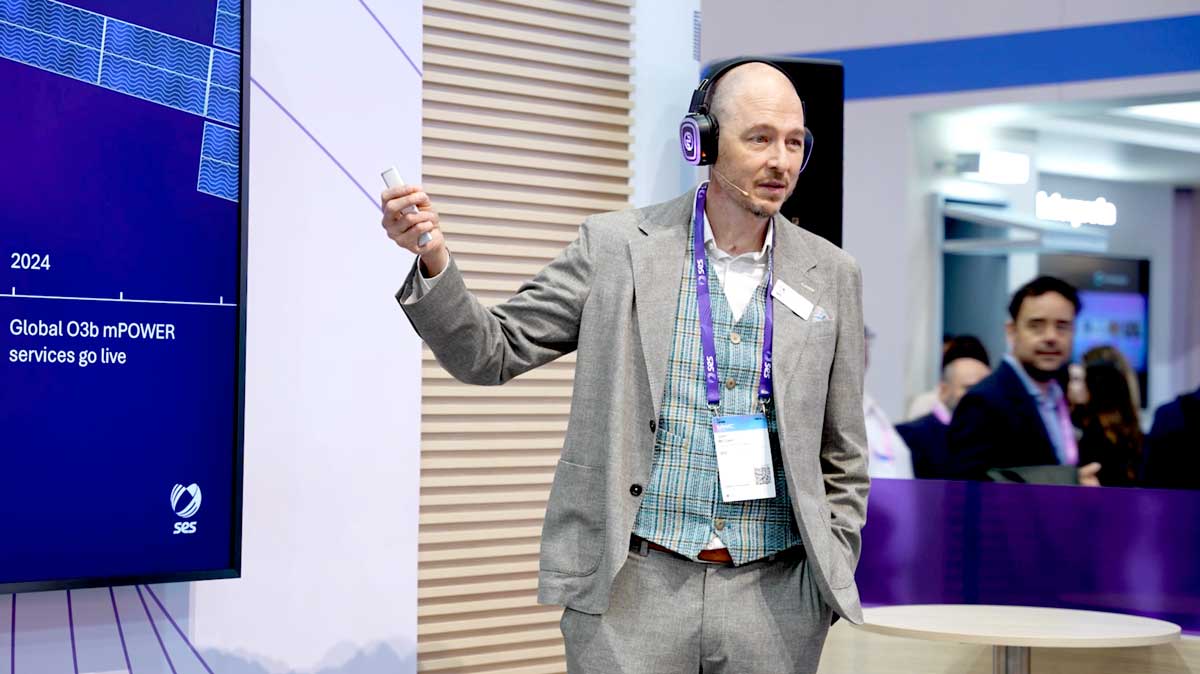
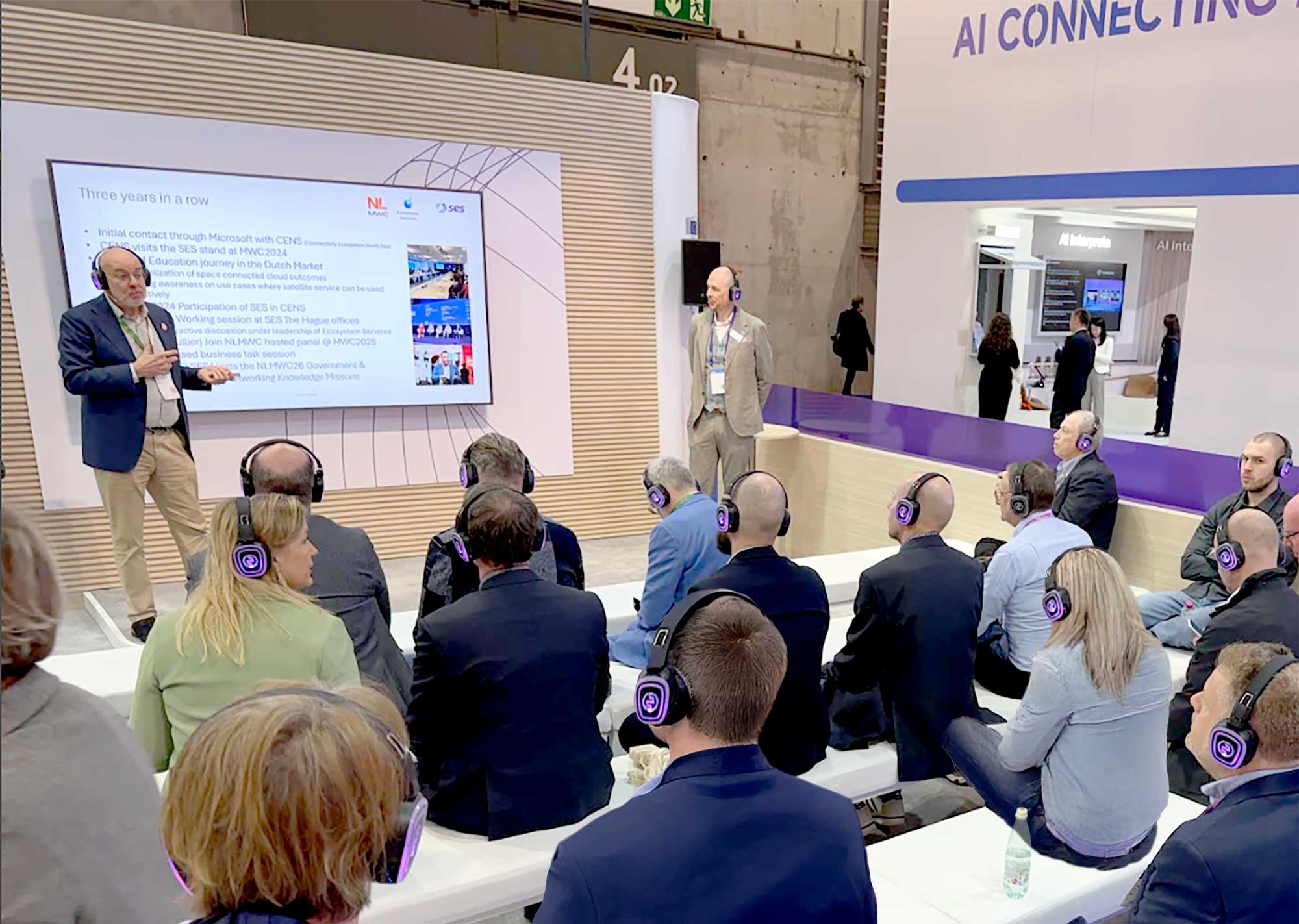
At MWC Barcelona 26, on Wednesday, March 4, a SES business talk “Building a trusted space ecosystem” was organised in cooperation with SES and Ecosystem Services as part of the NL@MWC knowledge missions Government and Innovation and Private Networks.
John McCann – director partnership program SES – (representing Maarten Verhaegh at SES Netherlands) welcomed the attendees to the SES Pavilion and introduced Mark Beermann from Ecosystem Services. This session marks the third year of the collaboration with SES on MWC.
Two audience groups are present: participants of the NLMWC knowledge missions Government & Innovation, and Private Networking groups.
Introduction Connectivity Ecosystem North Sea (CENS) Initiative
Mark Beermann outlines the background of the “Connectivity Ecosystem North Sea” CENS initiative, originally started with Fred Hage and Rijkswaterstaat (the Dutch government body responsible for North Sea infrastructure). Six government departments share responsibility for the North Sea; connectivity in this area is not guaranteed and requires dedicated attention.
Partner companies involved in the initiative include Port of Rotterdam, Cisco, SES, CityMesh, KPN, Nokia, Frontier, Rijkswaterstaat and TKI Offshore Energy; multiple knowledge and collaboration sessions were held across 2024 and 2025.
The goal is to improve overall digital connectivity and support for all user groups operating on the North Sea.
SES Overview – Orbits & Multi-Orbit Strategy
John McCann continued: SES and Intelsat have recently merged under the SES brand, creating a major satellite provider with assets across all orbital levels.
Three key orbits are explained:
- LEO (500–1,250 km): Low latency, fast handovers, Starlink/OneWeb; Link operates here.
- MEO (~8,000 km): High bandwidth (~1 Gbps per beam), wide field of view; SES is the only MEO operator.
- GEO: Most reliable, 50–60 years of history, still widely used at sea for SCADA and email.
SES is developing multi-orbit software and hardware to dynamically route traffic to the most suitable orbit based on application needs (e.g., LEO for video calls, MEO for mission-critical systems, GEO for SCADA/email).
MEO constellation history: O3B launched 2013, M-Power launched 2024; next generation called meoSphere is in development.
Industrial Digitization & Sovereign Space
SES aims to deliver carrier-grade, SLA-assured connectivity over satellite — indistinguishable from terrestrial connectivity — for industries such as shipping, offshore oil/gas, and mining.
Traffic prioritization is built in: voice, critical communications, and standard data are handled according to their respective requirements. SES is part of Iris², a European consortium (with Hispasat, Eutelsat, and others) focused on providing sovereign space — dedicated, sliced satellite capacity for national and governmental use.
Iris² is a governmental program; full details are restricted, but the initiative reflects growing national interest in space as critical infrastructure.
Lynk – Direct-to-Device Satellite Technology
Mahmoud Khafagy, VP of Product Management at Lynk, introduces the company’s direct-to-device (D2D) satellite capability.
Lynk connects standard mobile phones directly to satellites — no hardware modification required — addressing coverage gaps where terrestrial cell towers cannot be deployed, such as maritime areas.
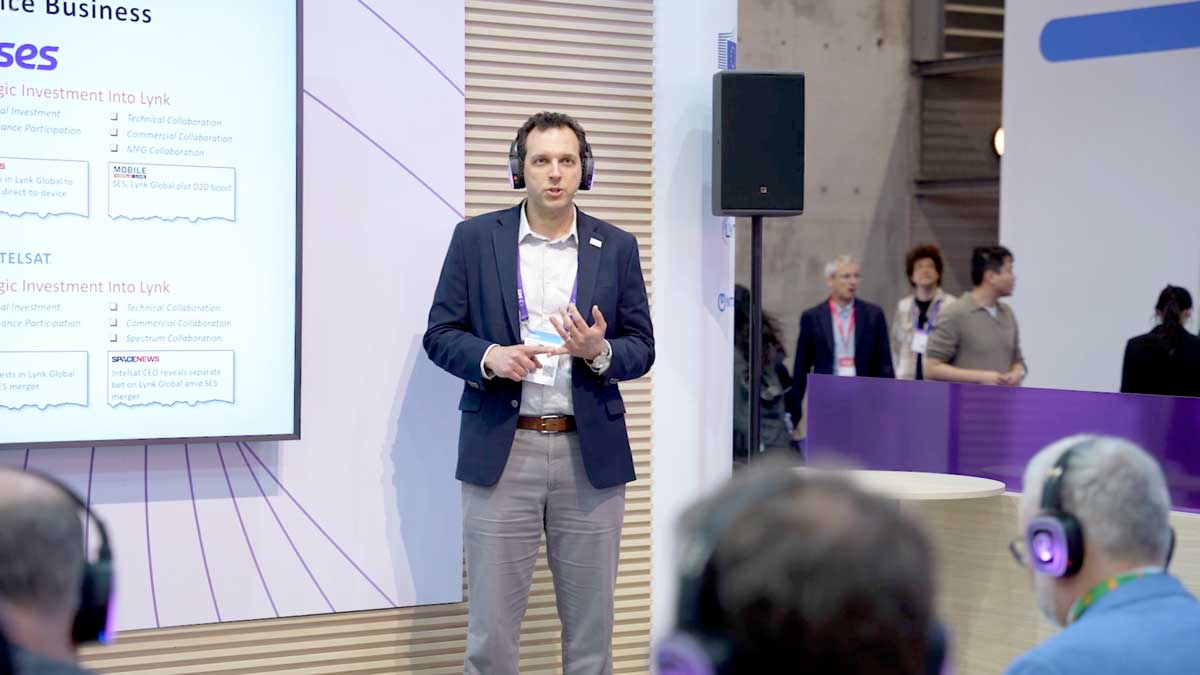
SES (and previously Intelsat separately) invested in Lynk; the partnership spans commercial, technical, operational, and spectrum dimensions.
Traffic from Link’s LEO satellites is routed via SES’s MEO/GEO infrastructure to ground stations, enabling real-time data sessions without Link needing to build its own global ground infrastructure.
Lynk recently merged with OmniSpace, gaining access to MSS (S-band) spectrum at the ITU level, future-proofing compatibility with new 3GPP-standard devices while remaining backward compatible with 2G/4G/5G devices.
Benefits for mobile network operators: expanded coverage, reduced churn, network backup, government/universal service compliance, and humanitarian response support.
Application to the North Sea
John McCann highlights that Lynk’s D2D capability could seamlessly cover the entire North Sea, filling coverage gaps between Dutch, English, and Norwegian mobile operator zones.
Any device with a SIM card could connect anywhere across the North Sea using this technology.