
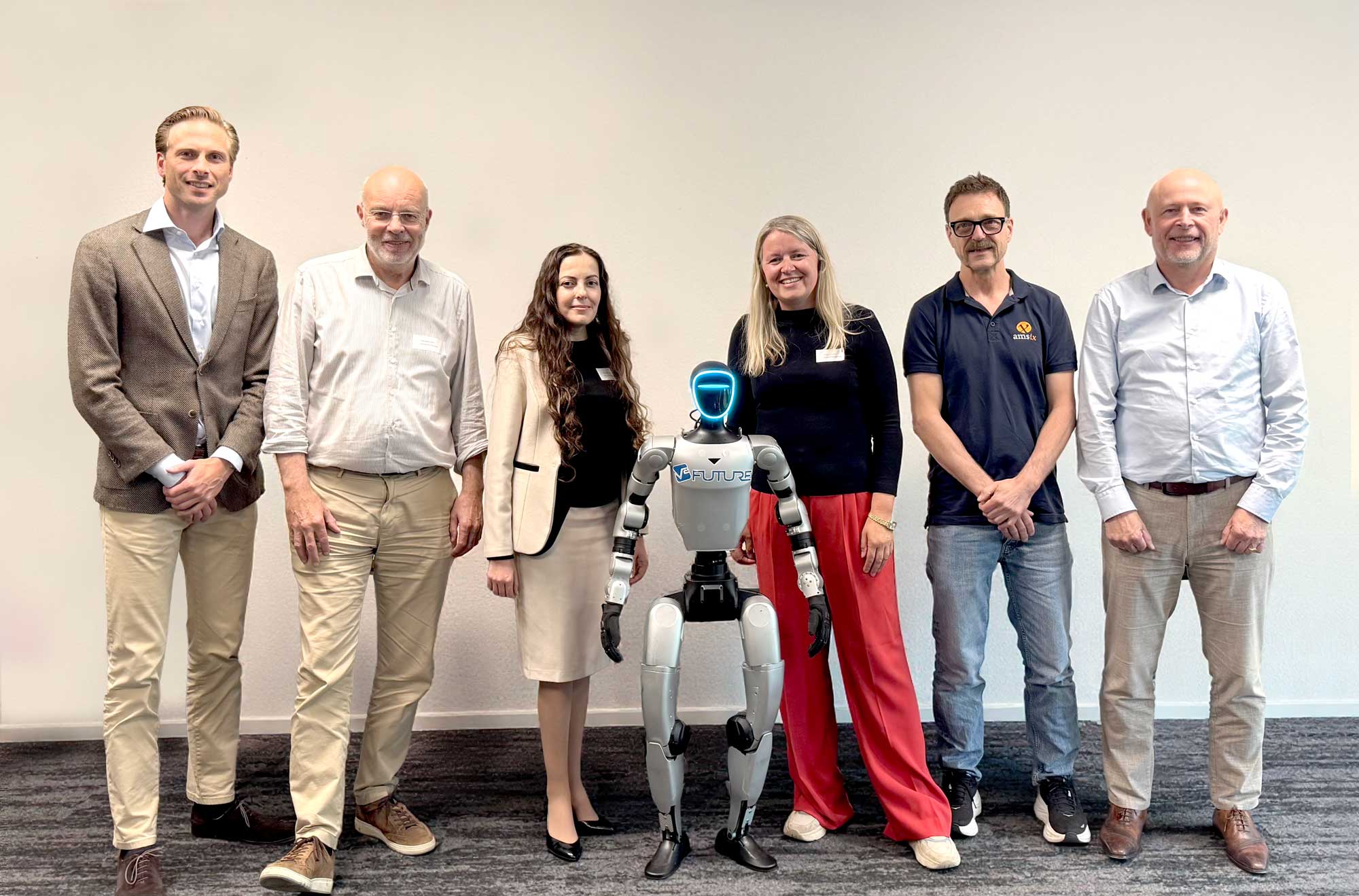
After the energy, scale and international buzz of MWC Barcelona, the Dutch MWC community came together once again on 4 June in Amstelveen for the NL@MWC Afterevent. Hosted at Amrop and organised by Ecosystem Services, the afternoon offered a moment to look back, reconnect and, above all, look ahead.
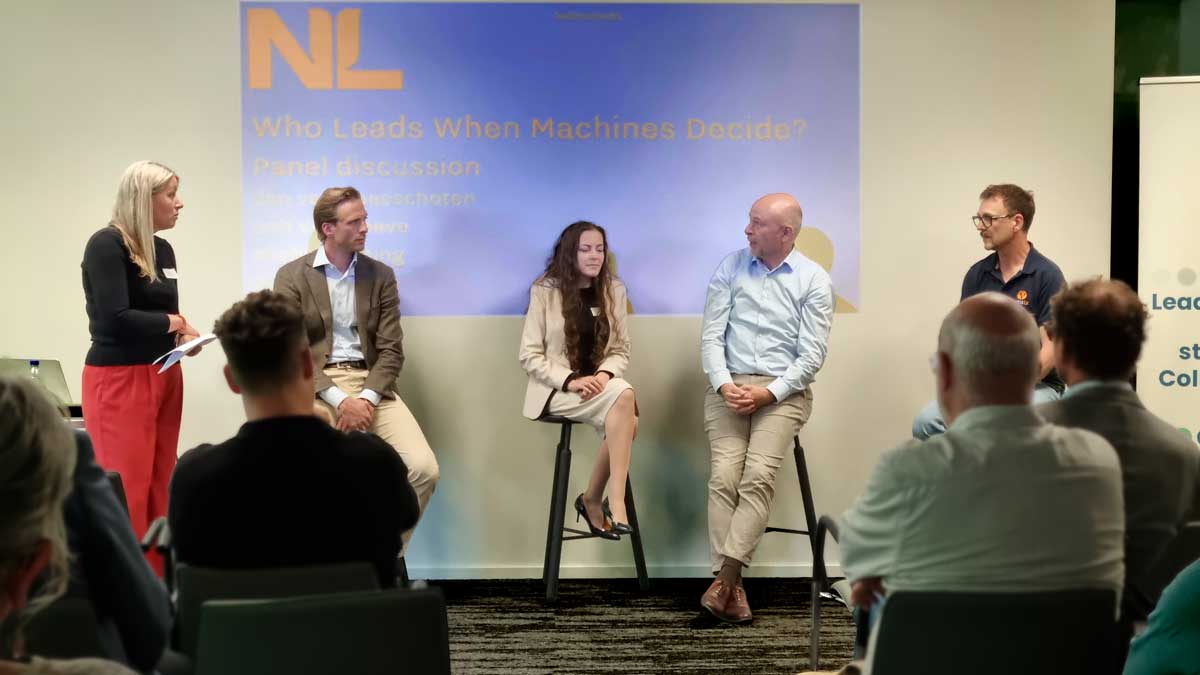
The theme could hardly have been more timely: Leadership in the age of AI and Robotics. Because while MWC is still the world’s leading meeting place for mobile and connectivity, the conversation has clearly expanded. Connectivity is now the foundation beneath AI, robotics, digital sovereignty, private networks, sustainable infrastructure and the next generation of autonomous systems.
From Telecom Event to Strategic Ecosystem
Opening the event, Anke Kuipers and Mark Beermann reflected on ten years of building the Dutch presence at MWC. What started as an initiative around telecom and mobile has grown into a strong public-private ecosystem, bringing together companies, government, knowledge institutions and innovators. The Dutch delegation in Barcelona has become more than a pavilion: it is a platform for visibility, matchmaking, knowledge sharing and strategic collaboration.
The recap of MWC Barcelona showed a community in motion. The Netherlands was present with a strong delegation, a broad range of exhibitors and startups, knowledge missions, networking events and international side programs. Summarized: MWC is not only a place to showcase technology, but a place where future partnerships are formed.
Learning from MWC: Private Networks and Digital Sustainability
The knowledge mission takeaways brought that future closer. Mark Beermann highlighted the importance of preparation, access and shared learning in such a large global arena with visits to Deutsche Telekom, GSMA, AWS, Huawei, Nokia, Ericsson, KPMG, SES, Business France and Estonia.
Koen Mioulet took the audience into the world of private 5G networks, where ports, logistics, industry and enterprise environments increasingly need guaranteed quality, latency and availability with learnings from Frontier, NTT Data, Viavi and Eurofiber. The visit on the second day to the Port of Barcelona made the discussion tangible: the future of connectivity is not theoretical; it is already being tested and used in cranes, terminals, vessels and industrial operations.
Digital sustainability was another key topic. As AI and digital infrastructure grow, so does the need to think seriously about energy use, circularity, responsible AI and sustainable value chains. The examples from Deutsche Telekom, Nokia, Fairphone, CEVA and Closing the loop, underlined that sustainability is no longer a side theme. It is becoming a strategic condition for digital growth.
The Rise of Physical AI and Autonomous Robotics
The afternoon then shifted from infrastructure to intelligence.
Dr. Vera Kovaleva, founder and architect of Robotics Advanced Intelligence, introduced the audience to the fast-emerging world of physical AI. Her work focuses on building a “brain” for autonomous robots, including humanoids. She mapped the development of robotics across hardware, software, learning loops, dexterity and autonomy. Her message was both exciting and challenging: robots are moving from programmed machines toward systems that can learn, adapt and operate in the real world. That raises a new generation of questions about safety, morality, autonomy and trust.
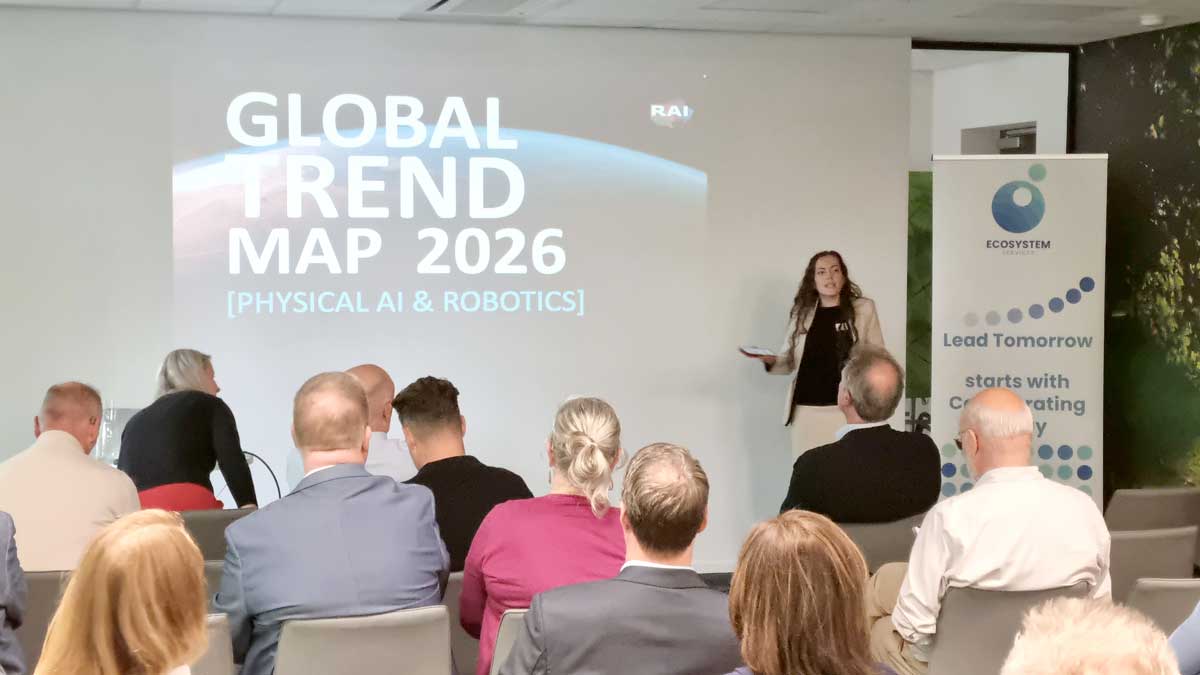
Leadership in the Age of AI
Job Voorhoeve, Partner at Amrop and Global Digital Practice Leader, connected this technological shift directly to leadership. His presentation on the rise of the Chief AI Officer made clear that AI is no longer only an IT topic. It touches strategy, ethics, organizational design, culture, workflows and competitiveness. The central question is not simply whether companies use AI, but who takes responsibility for how AI changes the organization.
AI Reshaping the Future of Connectivity
From Brussels, Tim Hatt of GSMA Intelligence placed the discussion in a global telecom perspective. He showed how AI is now woven through the major themes of MWC: networks, infrastructure, society, business models and disruption. For mobile operators, AI is moving beyond cost savings and automation. It is becoming part of how networks are managed, how services are built and how future connectivity ecosystems are shaped. He also pointed to non-terrestrial networks, 6G, edge computing, sovereignty and new network architectures as themes to watch.
Digital Sovereignty and Europe’s Position in Robotics
The event then moved into one of Europe’s most urgent digital questions: sovereign data exchange. Jan van Boesschoten, Innovation Manager at AMS-IX, shared the journey toward trusted data exchange and the role of neutral infrastructure in an increasingly complex digital economy. His perspective connected strongly with the Dutch and European ambition to build digital systems that are open, secure, interoperable and value-driven.
Humanoid Robotics: Europe’s Opportunity to Lead
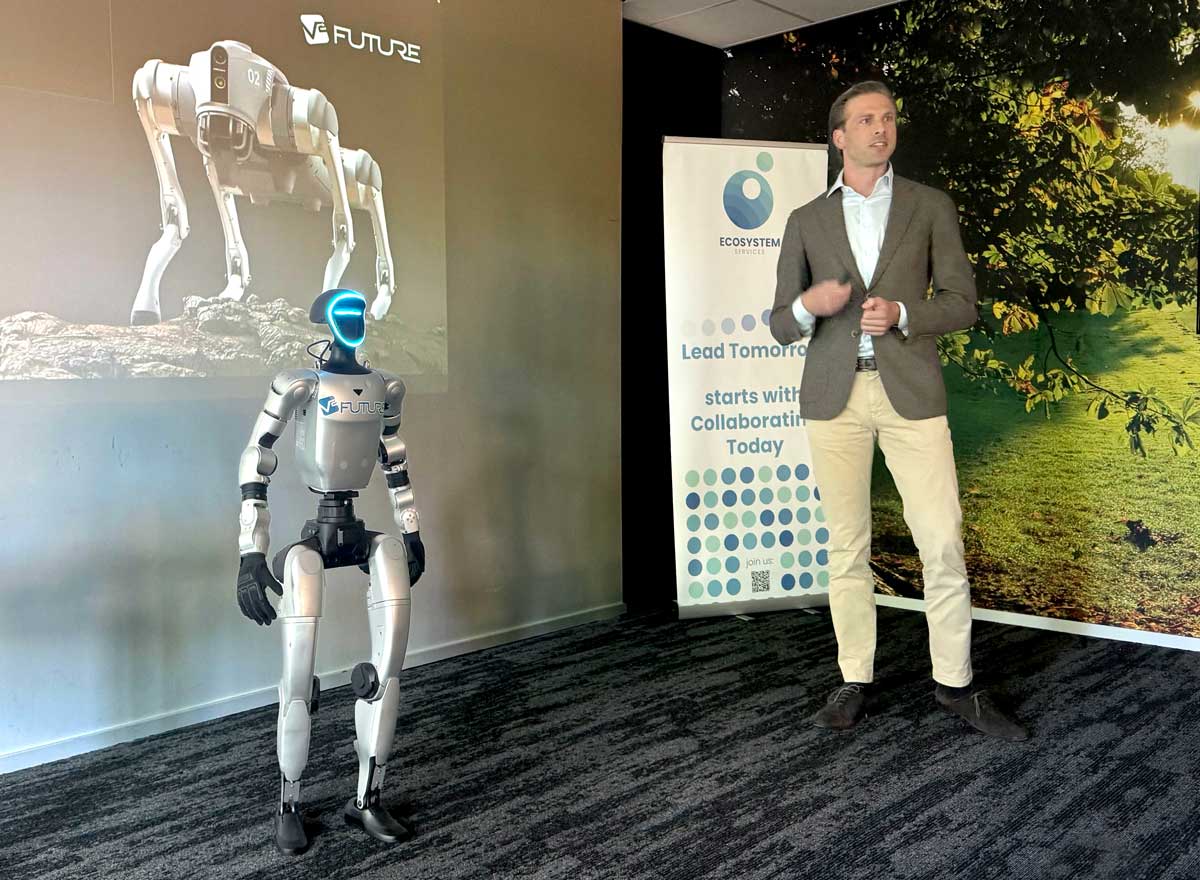
Michiel Ebbing of V2FUTURE brought the audience face to face with the rise of humanoid robotics, and brought the humanoid G1 as one of the guests. Drawing on his experience between Europe and China, he described how quickly Chinese robotics companies are moving from innovation to deployment. His message was not one of fear, but of realism and opportunity. Europe has strengths that are essential for deployment: trust, regulation, design, market understanding and social acceptance. The question is how Europe can collaborate, learn and lead in a field that is moving extremely fast.
Who Leads When Machines Decide?
The closing panel, moderated by Anke Kuipers, “Who Leads When Machines Decide?”, brought these threads together. Jan van Boesschoten, Job Voorhoeve, Michiel Ebbing and Vera Kovaleva explored power, accountability and human judgement in an age where AI systems increasingly support, influence or even make decisions.
One of the most powerful questions was what society should never delegate to AI. The answers ranged from love, to life-and-death decisions, to culture, creativity and care. The discussion made clear that leadership in the AI age is not about controlling every technology. It is about knowing what must remain human
By the end of the afternoon it became clear that AI and robotics are not distant trends waiting somewhere in the future. They are already reshaping networks, organizations, infrastructure, industries and leadership itself today. The real challenge is not whether the technology will arrive, but whether we are prepared to guide it with responsibility, courage and imagination.
It is a start and invitation where we all must rethink how we have currently organized our lives. It raises questions like who will pay taxes when robots do the work? What will people do in the future (if not work) that will give purpose? Who will be in the lead for driving the moral compass of Robots or AI? And will we allow robots to outsmart people?
The NL@MWC after event showed the strength of the Dutch ecosystem: curious, internationally connected, technically ambitious and willing to ask the difficult questions.