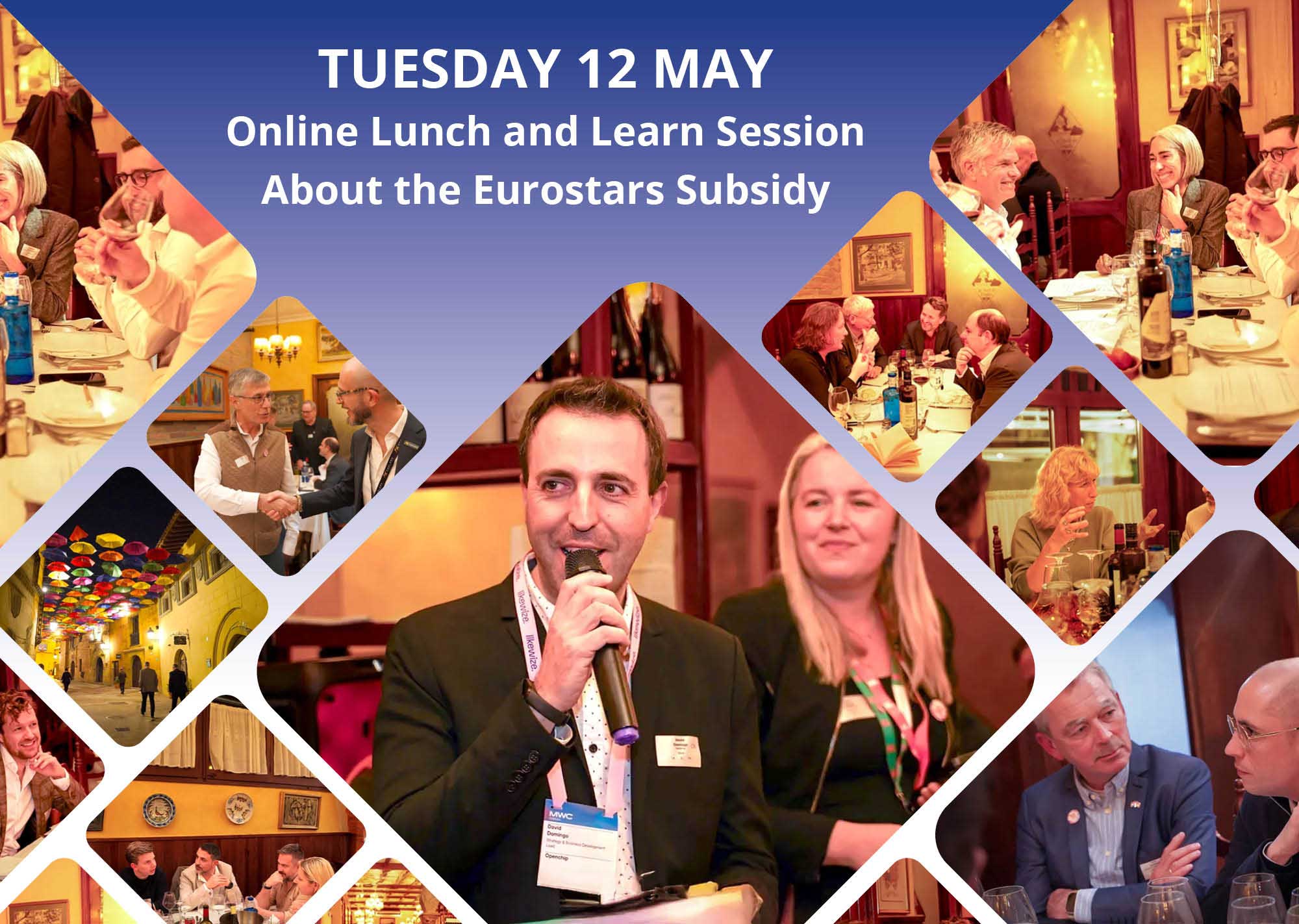
How can Dutch and European tech companies connect more effectively, collaborate on impactful innovation, and access the right funding opportunities? Ecosystem Services hosted an online Lunch & Learn session with the NL@MWC community about the Eurostars subsidy, together with subsidy expert Willem Maas from SubsidyCloud.
The session brought together entrepreneurs, innovators, and community members around one shared question: how can we turn European collaboration into concrete, fundable projects?
Eurostars is an international funding programme for innovative SMEs that want to develop R&D projects with partners from other countries. For internationally oriented companies, or businesses looking to bring technology from prototype closer to market, Eurostars can be a highly relevant route. The programme supports projects involving at least two independent organizations from two Eurostars countries, with a clear focus on market-oriented innovation.
Eurostars beyond healthtech
One key takeaway from the session was that Eurostars is not limited to medical or healthtech innovation. It is broadly applicable across sectors, including deep tech, AI, IoT, data spaces, forecasting, telecom, digital media, and other technology-driven applications. The programme follows a bottom-up approach: companies define the topic themselves, as long as the project is innovative, international, and market-focused.
Willem Maas explained that Eurostars has a relatively high success rate compared with many other European subsidy programmes, while the administrative burden is more manageable than in larger EU schemes. For Dutch SMEs, funding can cover up to 50% of R&D costs, with a maximum of €500,000 per partner. The remaining investment usually comes from own resources, internal hours, or private funding. In some cases, Eurostars can also be combined with fiscal instruments such as WBSO.
Collaboration as the starting point
Beyond the funding details, the session was designed to create connection. Participants shared projects and ambitions ranging from international data space pilots and AI applications to collaborations with French technology partners and innovation in physical industries. This reflected the purpose of the NL@MWC community: bringing people, ideas, and organizations together across borders.
A strong Eurostars application requires a solid consortium, clearly defined work packages, realistic milestones, and a convincing commercialization plan. Impact is also essential, not only technological impact, but also economic, societal, and where relevant environmental impact. Projects are more competitive when they are supported by concrete figures, customer needs, market validation, and a clear understanding of technical risks.
Looking ahead to the next deadline
The next Eurostars deadline is in September. Companies considering an application are encouraged to start early by shaping their consortium, refining the project idea, and checking the financial and formal requirements.
With this Lunch & Learn, Ecosystem Services and the NL@MWC community took another step in strengthening a European innovation community. Not only by sharing knowledge about funding, but by enabling collaboration between companies that can reinforce each other.
Are you exploring whether your project could be a fit for Eurostars, or are you looking for European partners for an innovative R&D project? Get in touch we would be happy to think along with you and share the presentation on request.
Partners