

At the Netherlands Pavilion during MWC Barcelona 2026, Sectra presented its Tiger E managed service, positioning it as a response to growing demand for sovereign and secure communication solutions beyond government use cases.
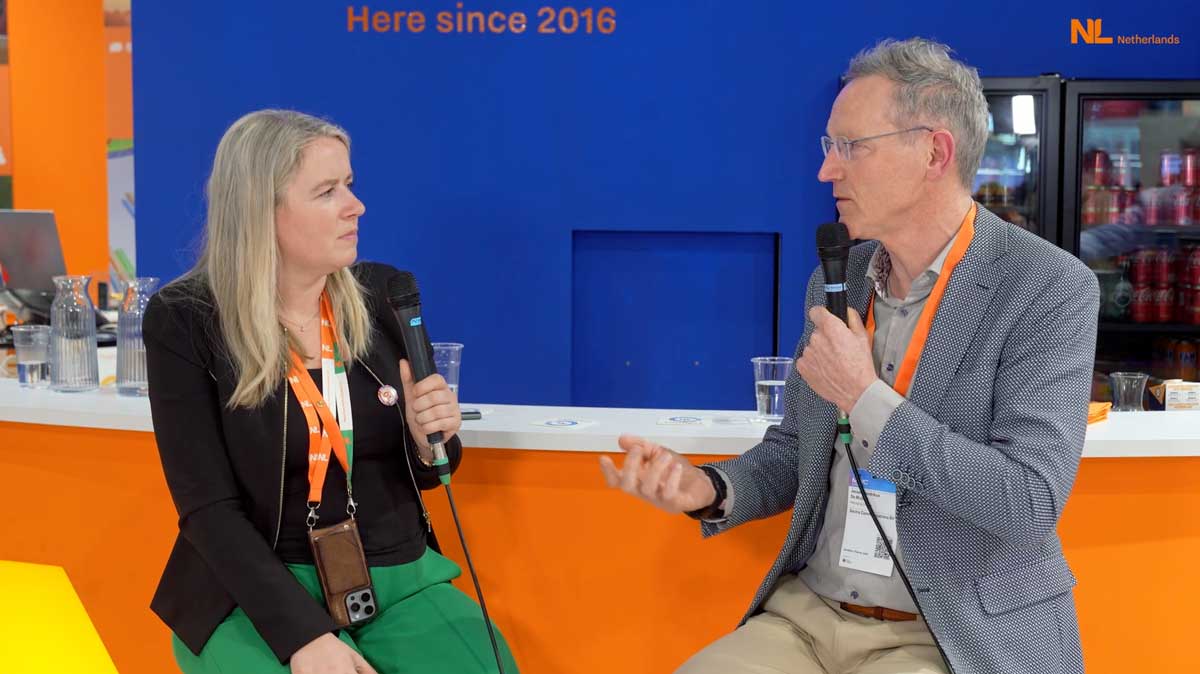
Speaking during an NL Talks session moderated by Anke Kuipers, Jeroen de Muijnck, managing director at Sectra, highlighted how increasing cybersecurity threats and geopolitical developments are reshaping requirements for secure communications.
Expanding from government-grade security to enterprise use
Sectra has traditionally focused on high-security communication solutions for government users, including systems designed to protect classified information. Its Tiger S solution, for example, is used in environments where state-level security is required.
With Tiger E, the company is extending these capabilities into a broader market segment, targeting organisations that face elevated security risks but do not require full state-secret-level protection.
De Muijnck described the new offering as a “sweet spot” between usability and high assurance, making secure communication more accessible for enterprises and government bodies operating in day-to-day environments.
Addressing vulnerabilities beyond technology
A key theme during the discussion was the role of human behaviour in cybersecurity risks. De Muijnck pointed to recent incidents, including warnings issued by European authorities about vulnerabilities in widely used messaging platforms, where social engineering attacks were used to gain access.
“These attacks don’t always target the system itself, but the user,” he said, emphasising that even secure technologies can be compromised through manipulation of end users.
Sectra’s approach combines hardened technology with user awareness measures, including training and operational guidance, to reduce the risk of human error in secure communication environments.
Integrated approach to secure communications
Unlike consumer-grade secure messaging apps, Sectra’s solutions are designed as integrated systems, combining hardware, software and key management.
The Tiger E service builds on the company’s experience in developing fully controlled security stacks, including proprietary cryptography and infrastructure, while adapting these capabilities for broader deployment.
According to de Muijnck, this approach aims to mitigate risks such as eavesdropping, phishing and unauthorised access, particularly in environments exposed to advanced persistent threats.
Sovereignty as a key market driver
The concept of digital sovereignty emerged as a central theme in the session. Sectra sees increasing demand from organisations seeking greater control over their communication infrastructure and reduced reliance on external providers.
De Muijnck noted that concerns include not only cyber threats but also geopolitical risks, such as the potential for external actors to disrupt or access communication systems.
“We want to avoid situations where others effectively have a ‘red button’ over critical infrastructure,” he said.
This trend is influencing procurement decisions across both public and private sectors, with organisations prioritising solutions that ensure autonomy and control over sensitive data.
Positioning within evolving telecom landscape
Sectra’s strategy also reflects broader changes in the telecom and technology landscape, where secure communication is increasingly layered on top of commercial networks.
Rather than building standalone infrastructure, the company leverages existing mobile ecosystems while adding its own security layer, including encryption and device-level protections.
This allows organisations to benefit from mainstream network capabilities while maintaining a higher level of security assurance.
Continued engagement at MWC
Sectra has been a recurring participant at the Netherlands Pavilion, using MWC Barcelona 2026 to track evolving trends in both technology and policy.
De Muijnck noted that themes such as 5G network slicing have shifted in prominence over time, while sovereignty and security are now moving to the forefront of industry discussions.
The company is positioning Tiger E as part of this shift, aiming to support organisations navigating an increasingly complex threat landscape while maintaining operational usability.