From vulnerability to resilience by design
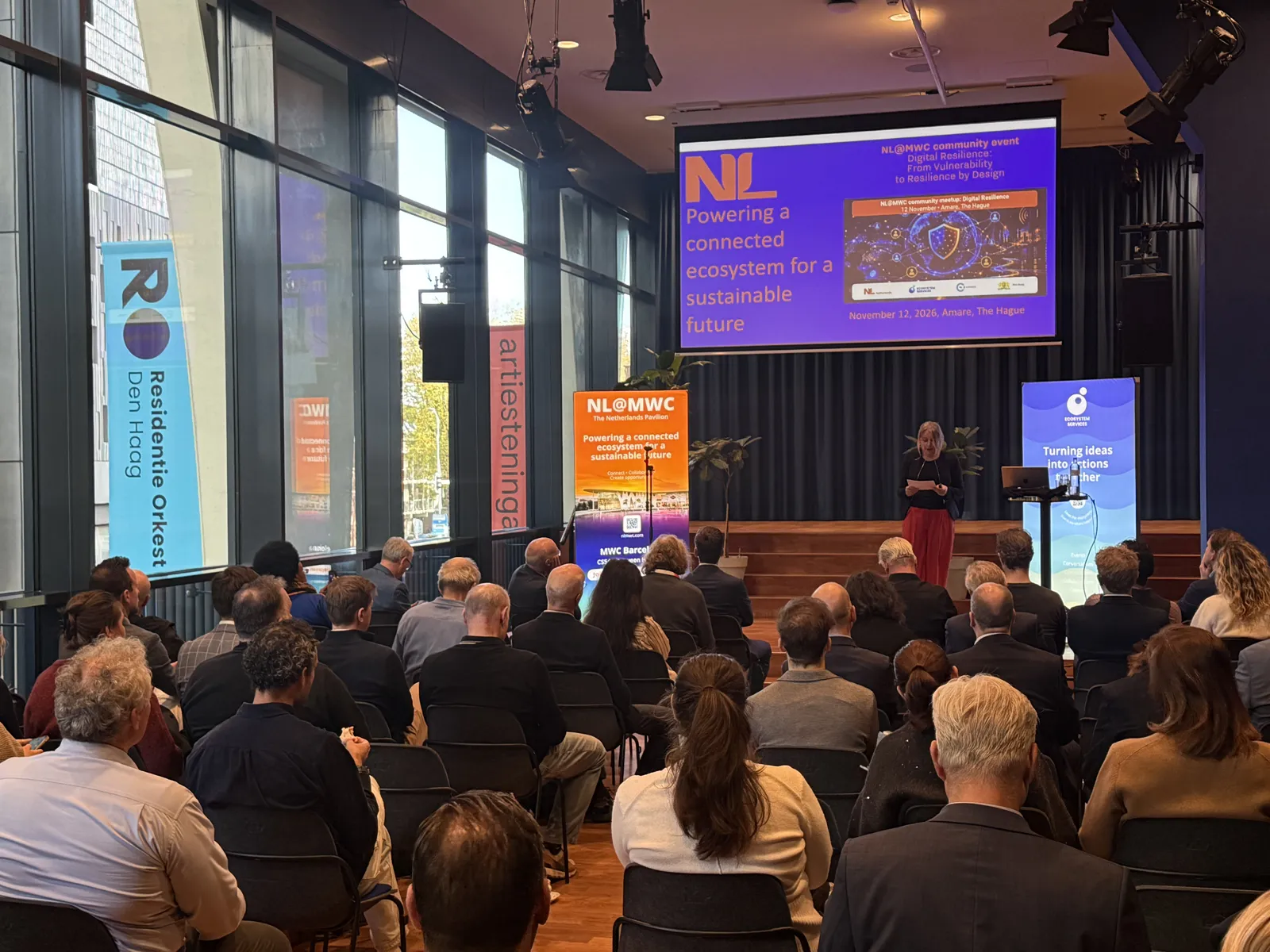
What happens when your phone still works, the network still works, but the cloud, identity or software service behind it fails? On 12 November, the NL@MWC community gathered at Amare in The Hague to answer that question … and left with homework.
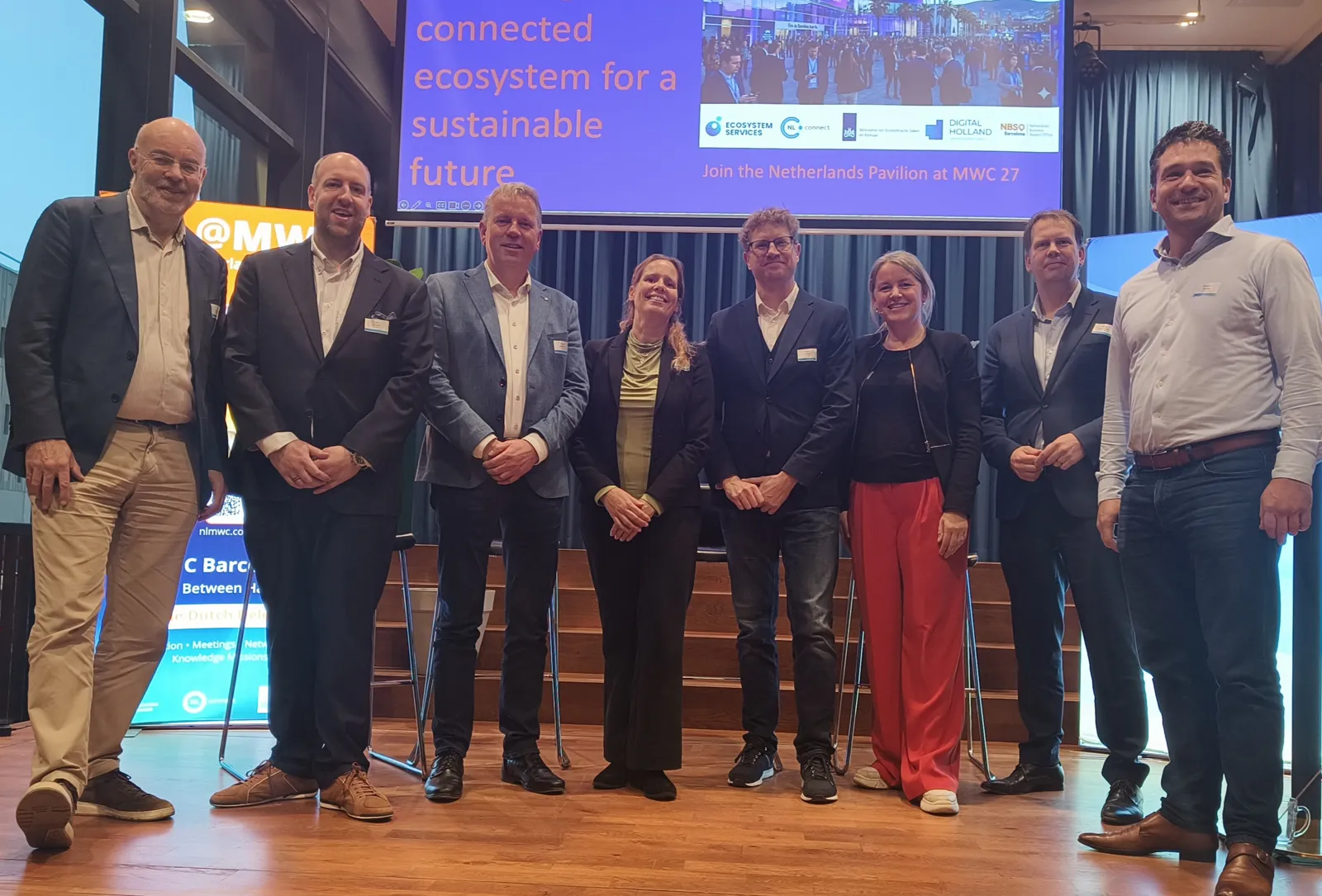
The afternoon, organised and hosted by Ecosystem Services together with the Municipality of The Hague as part of the run-up to MWC Barcelona 2027, brought together speakers from Clingendael, the Dutch Authority for Digital Infrastructure (RDI), Eurofiber, Falqon Systems, Schwarz Digits, Fortaegis and the city itself. Moderated by Anke Kuipers, the programme moved from geopolitics to data centres, from quantum physics to silicon, and finally to the streets of The Hague. The thread running through it all: resilience is not something you buy. It is something you design, together.
Start with geopolitics: who really controls your data?
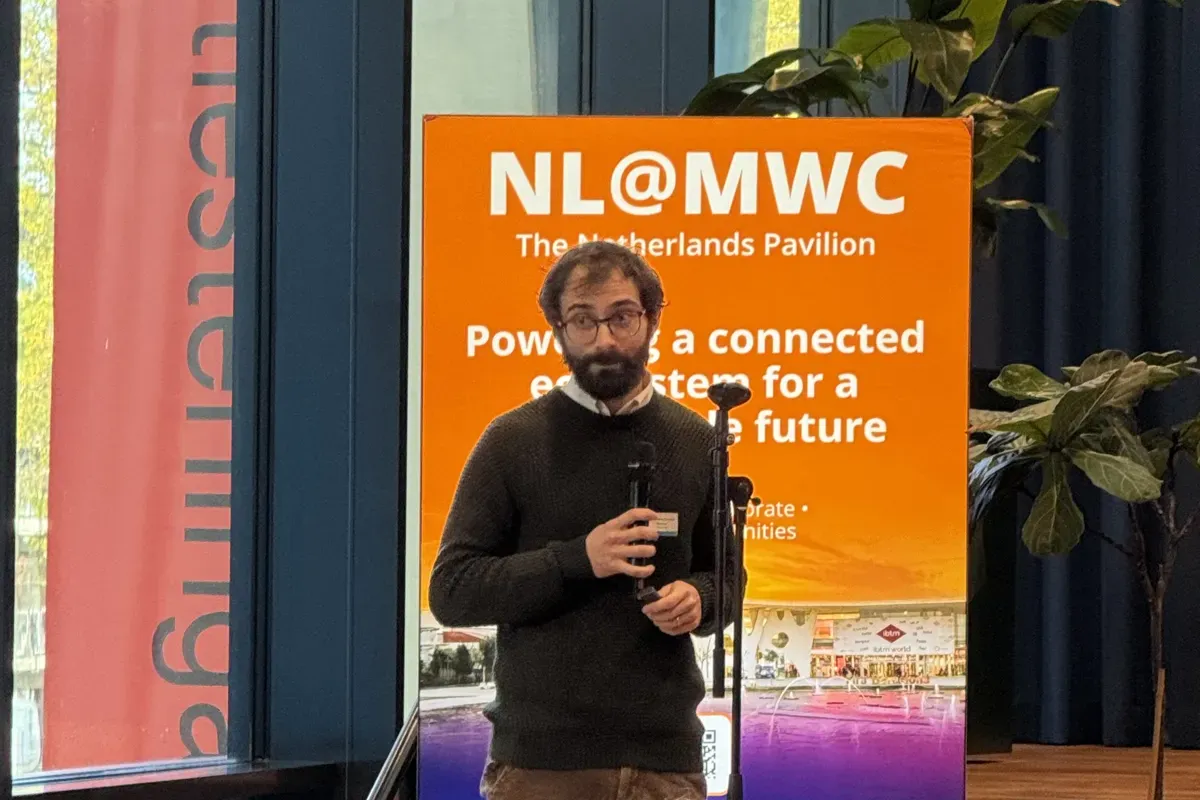
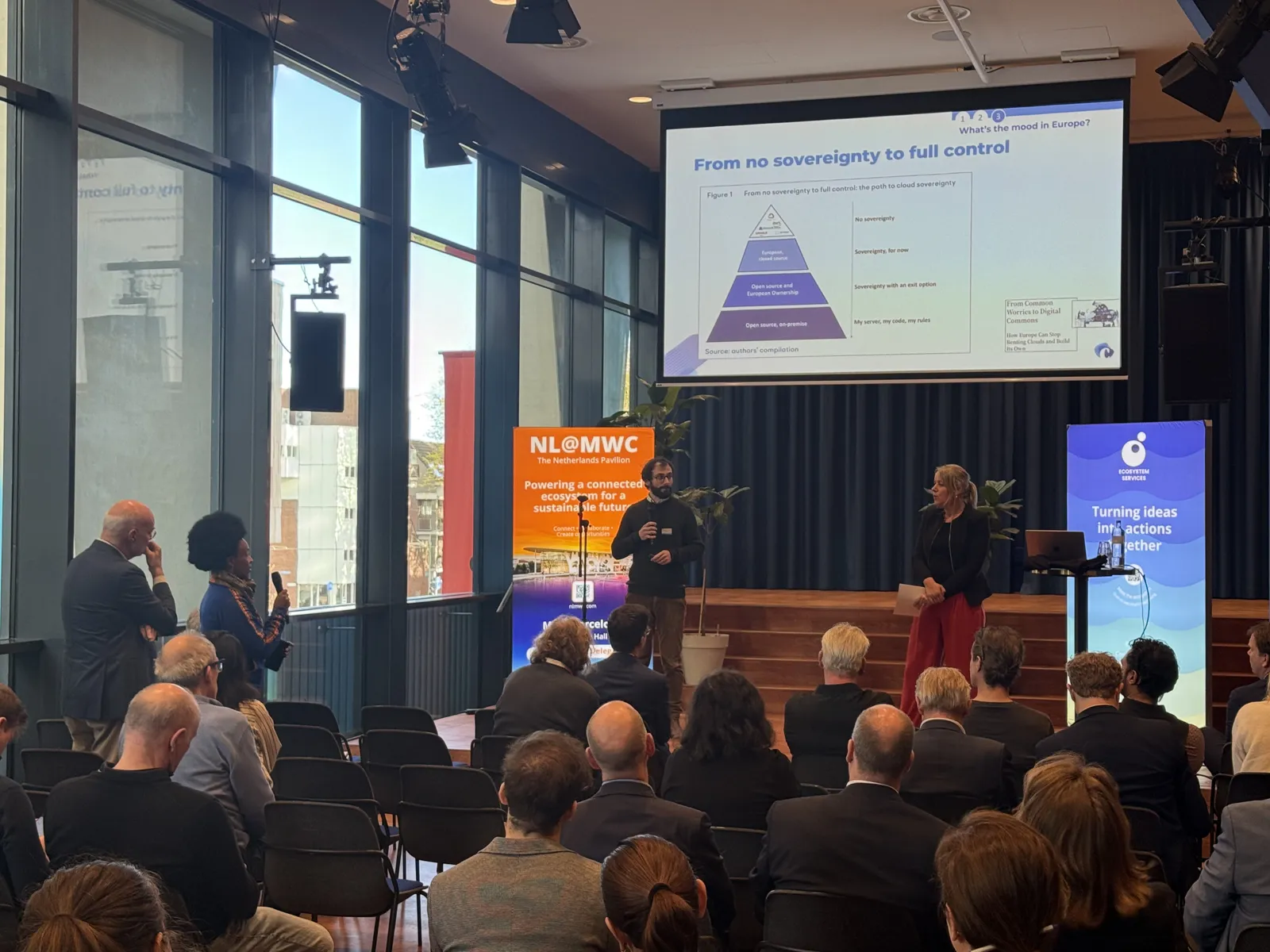
Alexandre Ferreira Gomes, Research Fellow at the Clingendael Institute, set the tone by placing digital resilience squarely in today’s geopolitical reality. Building on Clingendael’s report From Common Worries to Digital Commons, he explained why data in an EU data centre is not automatically safe from foreign reach: US instruments such as executive orders, sanctions and FISA 702 can still apply when the provider is American.
He walked the audience through a ladder of sovereignty:
- No real sovereignty — the “sovereign” offerings of non-European hyperscalers, which the report calls digital sovereignty washing.
- Sovereignty for now — European providers that are sovereign as long as nobody else buys them.
- Sovereignty with an exit option — managed open-source services from European players, which you can take elsewhere if you need to.
- Maximum sovereignty — open source, on premise.
Not every organisation needs the top rung, he stressed. The local library or bakery may be fine as it is. But a Ministry of Defence, water management or parts of healthcare deserve a much harder look at their dependencies.
The Q&A showed how alive the topic is. Asked how Europe avoids “falling back asleep” once US politics changes, Gomes shared an anecdote from a bank boardroom, where someone asked whether they should then look at Chinese alternatives instead. It revealed two things, he said: we only look at the others, and we barely know our own European options. What Europe needs most now are success stories. His request to the room: if you are migrating away from non-European providers, share your story publicly, including what went wrong.
The room responded immediately. iMotivate described its own migration, starting with email, and named managing people as the biggest challenge. A participant building open-source software for civil society pointed out that NGOs hold extremely sensitive data, on refugees and victims of gender-based violence, yet lack funding to move. A sovereign-workplace provider replied that small NGOs are already migrating successfully, and noted a familiar pattern: everyone wants to move, but wants someone else to go first. A final question on supply-chain attacks drew a pragmatic answer: you can follow the dependency chain all the way down to chips and raw materials. Focus on what Europe can control, and move together as a continent.
The regulator’s view: resilience doesn’t stop at your front door
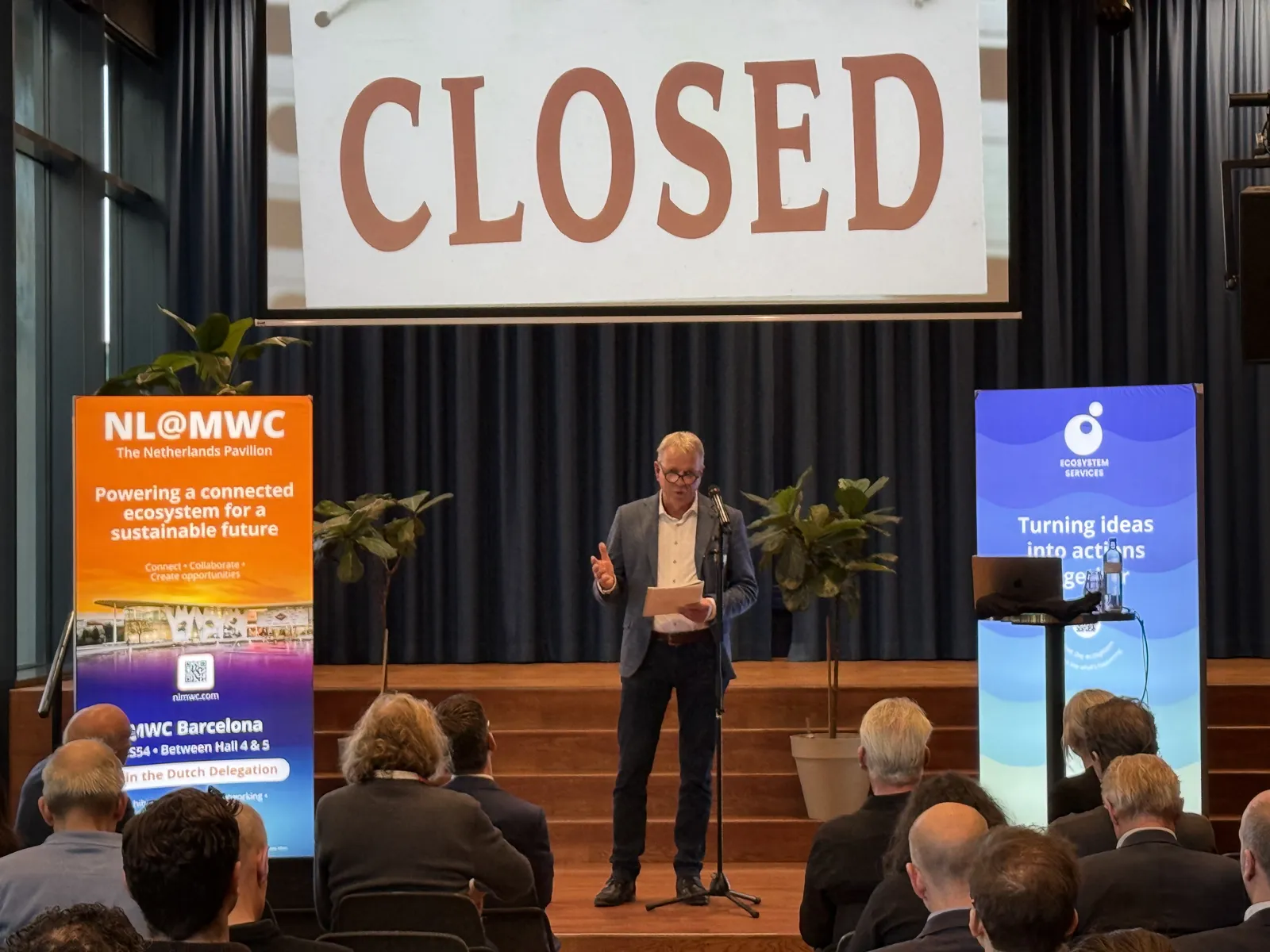
René Vroom, manager Digital Resilience at the RDI, opened with the question that framed the whole day: if your phone and the network still work, but the service behind them fails, are you still resilient? And if a dependency was known, but the damage lands mainly on others, can you still call it responsible innovation?
The Netherlands is small but far from insignificant, Vroom reminded the room: Rotterdam, ASML, world-class tech clusters around Delft and Eindhoven, major internet exchanges. That connectedness is a strength, and a responsibility. Pointing to the NCTV’s 2026 national risk assessment, he described scenarios in which an outage at a major cloud provider, or a disruption where digital meets physical, has major consequences for society. Recent incidents made it concrete: the ChipSoft attack hitting healthcare, precautionary shutdowns at a large supermarket, the Citrix vulnerabilities, and hacks of cooling equipment at French blood services and at supermarkets in France, Belgium and the Netherlands.
His core message: know your assets, know your dependencies, know your risks. Which suppliers are critical to your core business? What has been agreed about outages, recovery and exit? And have you rehearsed those scenarios with the parties you would actually need in a crisis?
Vroom also highlighted the joint white paper The Route to Digital Autonomy by five Dutch regulators, including the RDI. Choosing a cloud is no longer just a technical decision. The RDI makes no political statement about providers from any particular country, he said, but looks at it as a risk question: how much control do you have, is there vendor lock-in, and how are you mitigating it?
Under the new Dutch Cyber Security Act (Cbw), which implements NIS2, supervision is shifting too. It moves from ticking boxes to asking organisations to show that their measures fit their risks. Open norms do not make the law optional, Vroom emphasised. Boards carry explicit responsibility and must be trained. The RDI wants to be “firm on the content and gentle on the relationship”, and is open to organising round tables where the sector sees a need.
He closed with two questions for the room, answered live via QR code: Which dependency do we still see as somebody else’s? And what can we do together to keep them manageable? Answers ranged from energy and chips to governance, legal frameworks and investment.
From theory to concrete: building a resilient AI factory
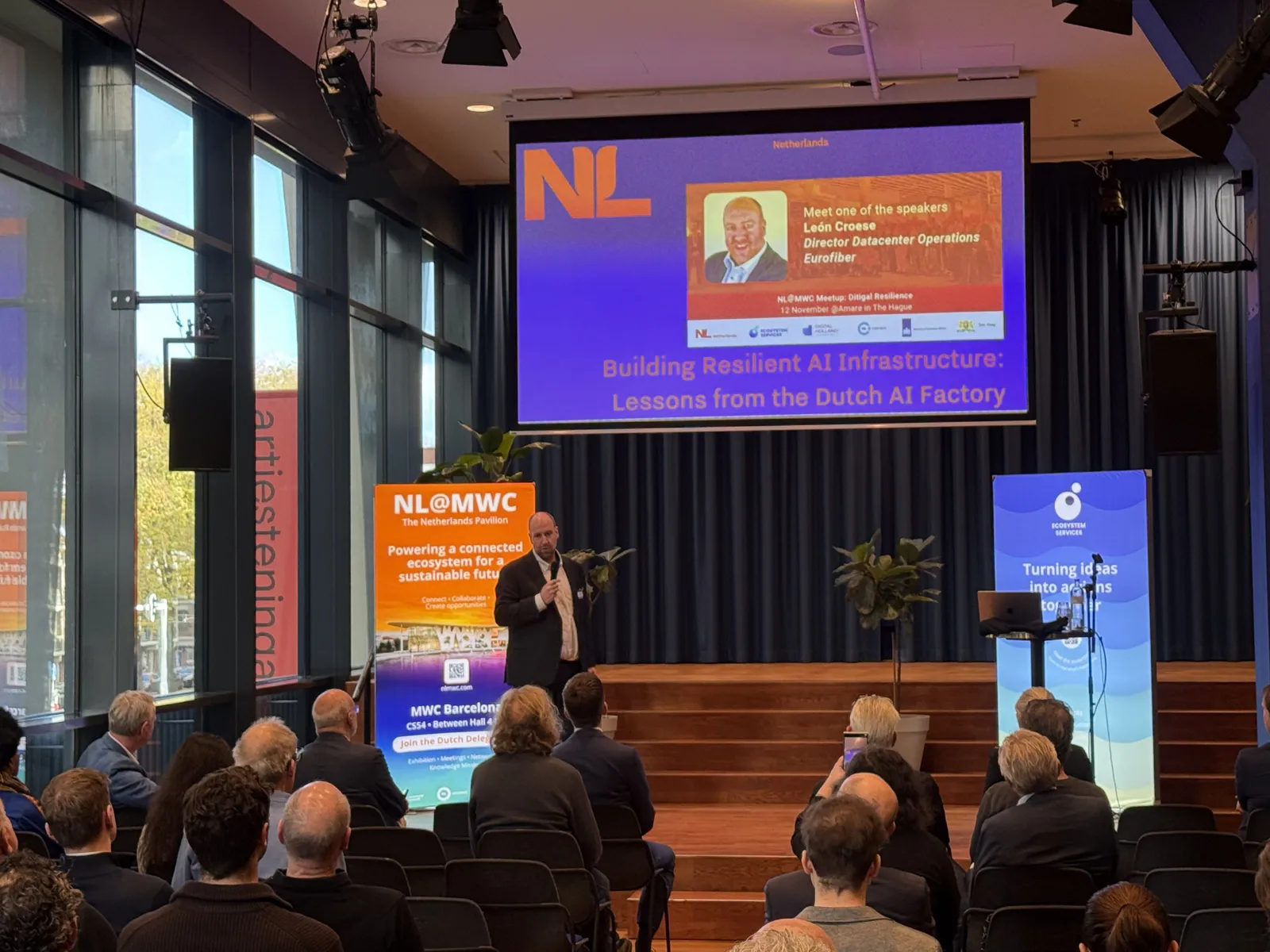
León Croese, Director of Operations at Eurofiber and responsible for its eight regional data centres in the Netherlands, took Gomes’ call for success stories to heart. Eurofiber began in 2000 as a fiber company and now runs about 77,500 km of fiber across five countries, plus data centers and a Dutch cloud. Its infrastructure is designated as vital by the Dutch government.
His case: the Dutch AI factory. SURF selected Eurofiber to host the national AI facility in its Groningen data center, giving education, research and government access to high-end AI compute on Dutch soil. AI changes the equation, León explained, and resilience now has four dimensions that all need to be right:
- Technical. A data center lasts 20 to 30 years; AI hardware two to three. So Eurofiber reversed the design process: start from the compute and its power density, then design the building around it.
- Energy. With grid congestion, power is no longer a given. The data center becomes a partner of the grid: backup generators and UPS batteries can support the local grid, and training workloads can shift away from peak moments.
- Environmental and social. Efficiency reduces cost and grid demand at the same time. In Groningen, in cooperation with WarmteStad, residual heat will warm about 2,000 homes, saving roughly 1.9 million cubic metres of gas, without using a single drop of drinking water for cooling. “The most sustainable megawatt is the megawatt you don’t need.”
- Sovereignty. It doesn’t stop at the software layer. It also takes skilled people, compute, energy, data centres and connectivity.
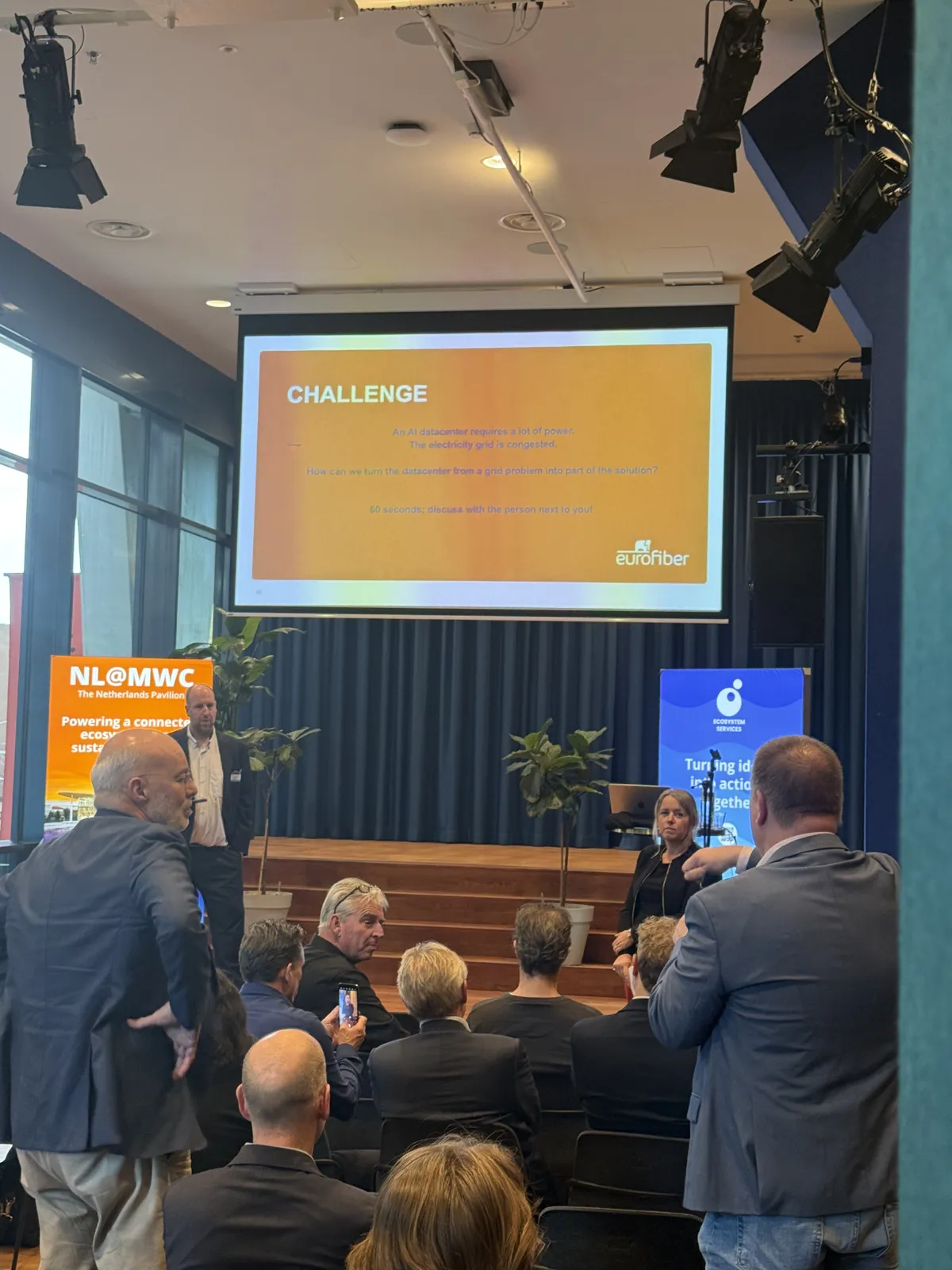
León then put the room to work: how can a new data center, on a grid that is already full, be part of the solution? Ideas came quickly, from tagging AI workloads by urgency to spread load across the day, to linking data centers with greenhouses for heat, to optical chips. His conclusion: “Resilience emerges from the system.” Europe cannot build sovereign AI without sovereign digital infrastructure.
Quantum: protect against quantum, with quantum
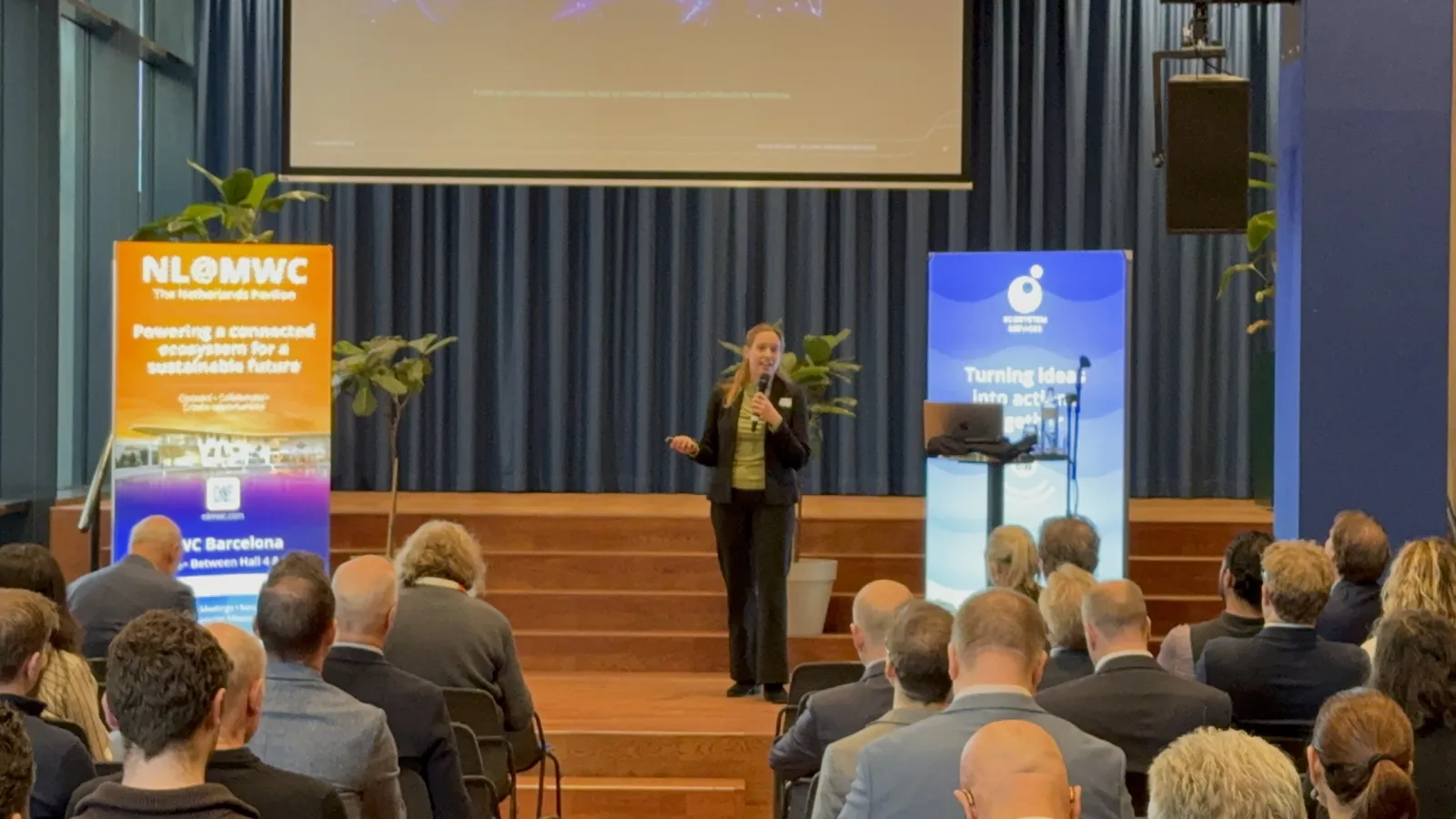
After the break, Ingrid Romijn, co-founder and CEO of Falqon Systems (until recently Q*Bird), took the stage. Two years ago she exhibited at the Netherlands Pavilion in Barcelona; today the QuTech spin-out has 30 people building quantum-secure networks.
The threat is known: quantum computers will be able to break the encryption we rely on today, and malicious actors may already be harvesting now to decrypt later. Post-quantum algorithms are a good first step, Romijn said, but they risk becoming a race of patch after patch. Quantum key distribution offers a different route: any attempt to eavesdrop on the quantum channel is detected. It adds a layer to existing infrastructure rather than replacing it.
Falqon’s approach, measurement-device-independent QKD, places the measurement at a central hub that never holds the key, which removes a well-known class of side-channel attacks and makes the network scalable: each new user simply adds one fibre to the hub. The company has deployed quantum-secure networks in seven European countries, with more than 50 devices and almost 1,500 km of network. Examples include a link between The Hague and Amsterdam for government organisations, the Port of Rotterdam test bed, and a new network between Hoofddorp and Delft in Eurofiber’s data centres, open for organisations to test their applications.
The geopolitical angle was striking: while US agencies advise against QKD, large US companies are buying up quantum-network firms, including European ones. Asia is simply building. Europe is moving through its EuroQCI programme, but too slowly for her taste. Her reflection on NL@MWC: two years ago she had to explain what quantum and a qubit were; now every tier-one telco in Europe has a quantum programme.
Sovereign cloud: can you walk away from the table?
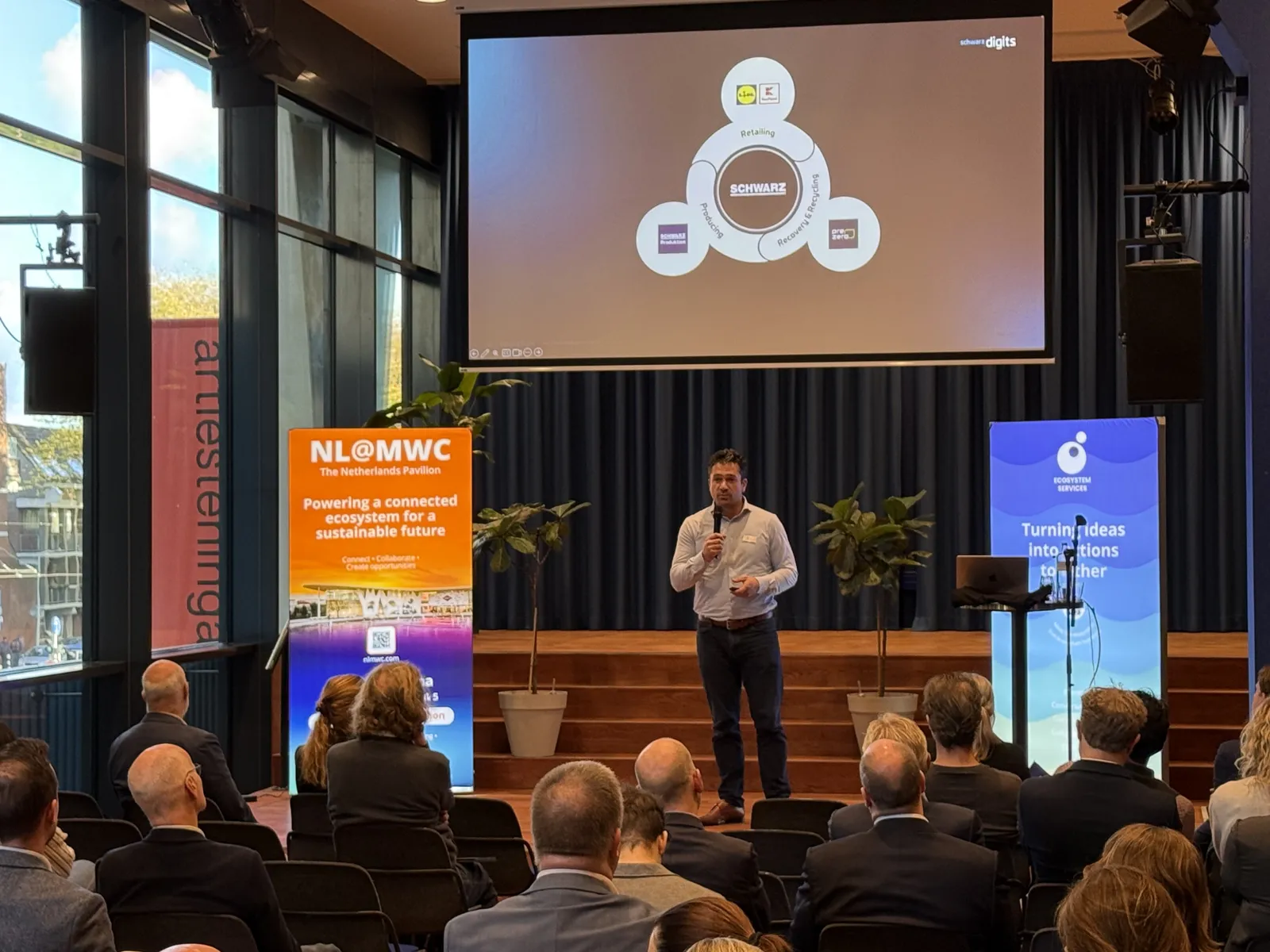
Stephano Bosman, who leads Schwarz Digits in the Benelux, spent his career at Dell, Microsoft and AWS before switching sides. He opened with a German saying about the donkey that dances on the ice when it feels too comfortable, a fitting image for Europe’s last two decades of digital dependency.
His central question came from retail. When Coca-Cola raised its prices, Lidl walked away and stocked alternatives, until Coca-Cola returned to the table. “Are you, with your organisation, able to walk away from the negotiation table at any moment in time?” For most organisations the honest answer is no; they have a vendor lock-in they don’t even see.
Schwarz Digits, the IT arm of the group behind Lidl and Kaufland, offers STACKIT cloud, cybersecurity, data and AI, communications via Wire, and workspace tools. In the Netherlands it builds on KPN’s existing data centres to speed up time to market. The principles: Schwarz Group itself is always customer zero (new solutions are first implemented on their own brands like Lidl), everything is built on open source to avoid creating a new European lock-in, and partnerships come first. Being realistic matters too: twenty years of US innovation can’t be replaced in four years. Be truly sovereign where it matters most, such as the data layer, and work with best-of-breed technology elsewhere. His anecdote of a major power outage in Berlin, where Lidl stores kept running on their own generators, satellite phones and payment systems, showed what designing for resilience looks like in practice.
Trust starts in the silicon
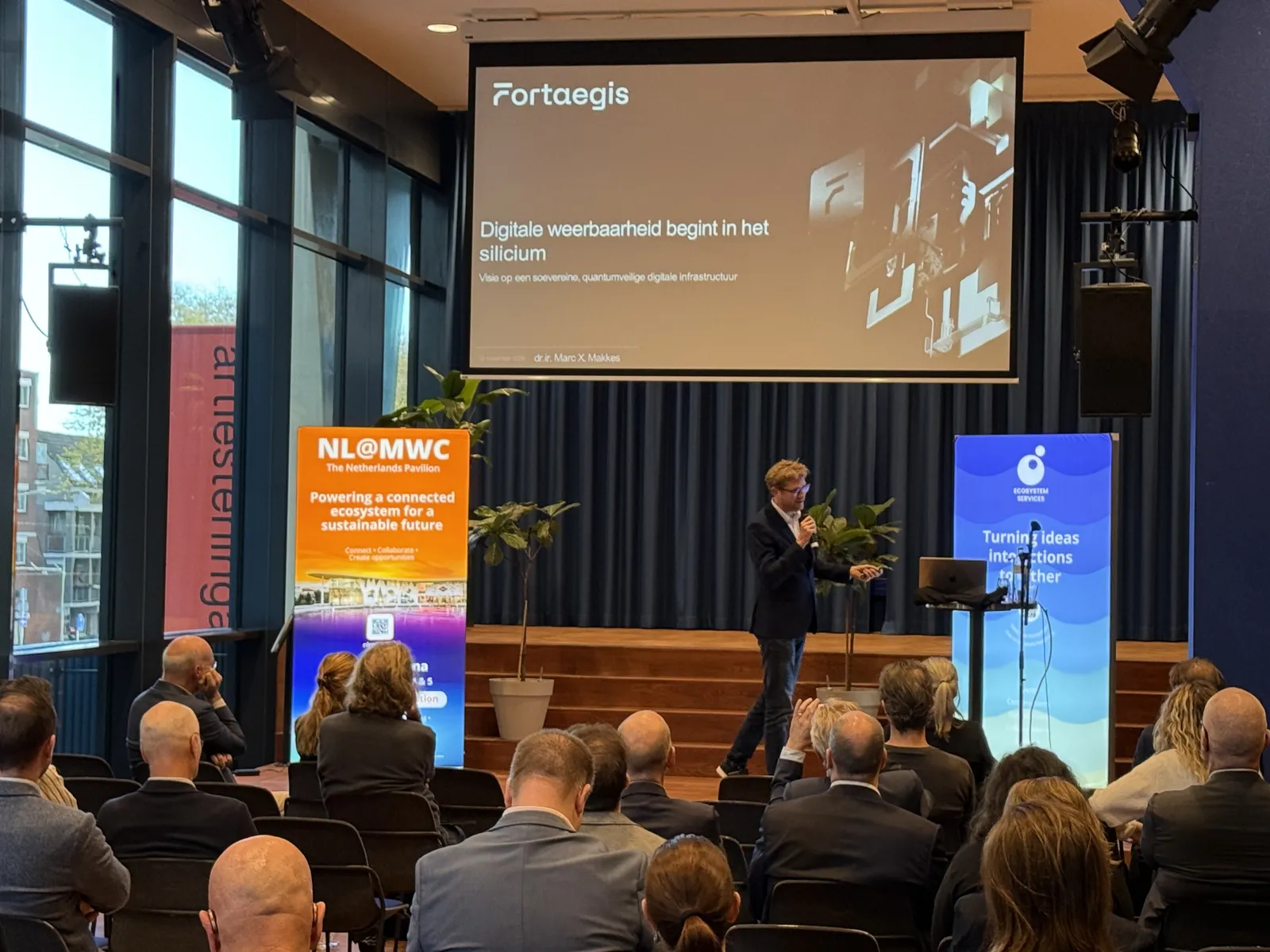
Marc Makkus, founding team member and Head of Research at Fortaegis, went one layer deeper. Founded three years ago in Amsterdam, the company has grown from two people to 90 and recently raised $50 million. Alongside the quantum clock, he warned, an “AI clock” is ticking: AI is exposing weaknesses in cryptographic algorithms, including post-quantum ones.
If trust is not in the infrastructure, you cannot build it on top. Fortaegis therefore embeds it in the chip, using the minute random variations in every piece of silicon as a unique fingerprint. Keys are generated on the fly and never stored, so they cannot be extracted, even from a crashed drone. The company says authentication and key exchange run more than 200 times faster than typical standards, which matters for drone swarms, defence, automotive, telecom and AI data centres. His closing line stayed with the room: “If you don’t own the keys, you probably don’t own the data.”
City of The Hague as end user: a 48-hour challenge
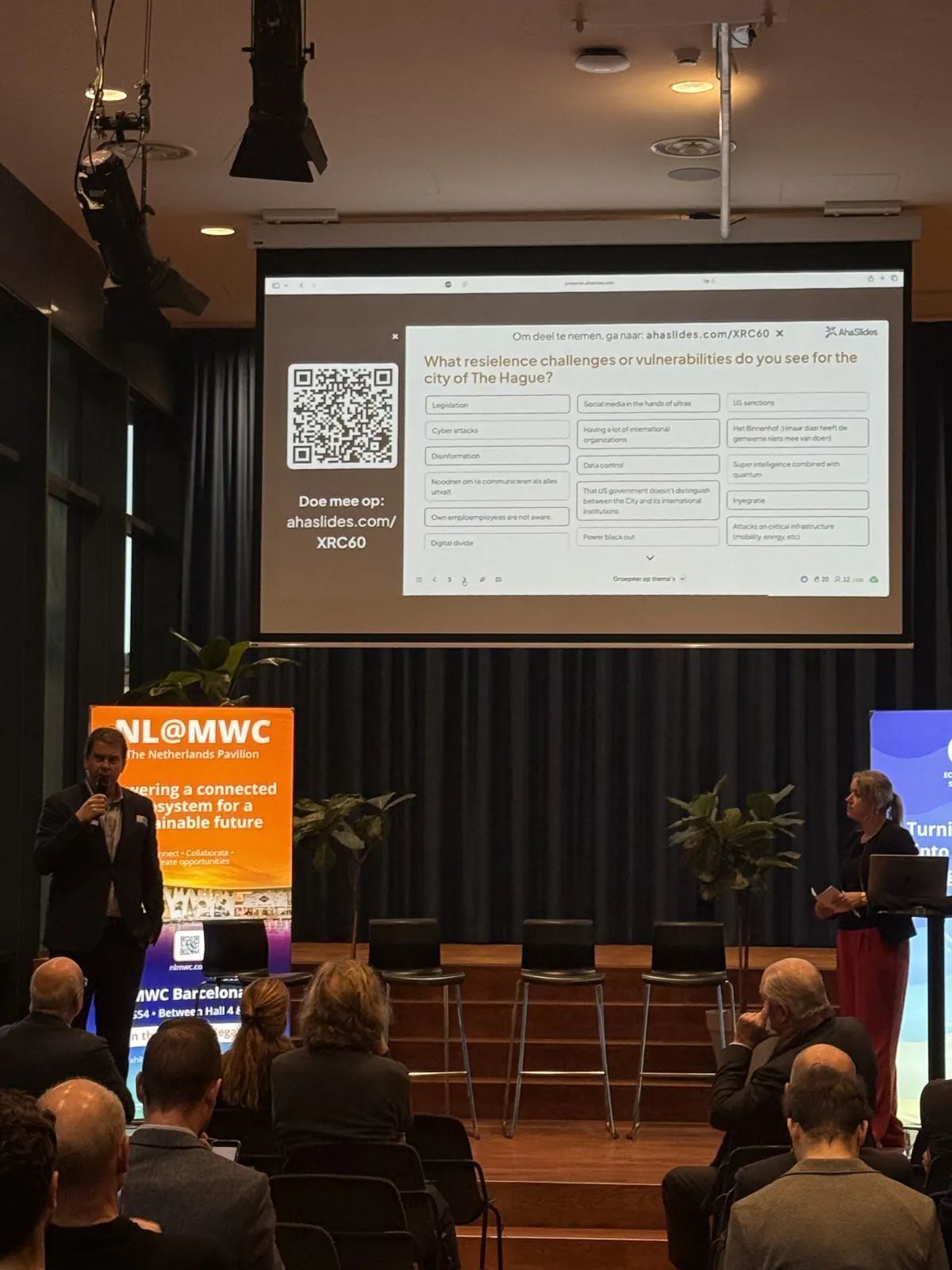
Then the day came home. “How many of you knew there was a Chief Resilience Officer in The Hague?” asked Wouter Beijersbergen van Henegouwen, who holds exactly that role. His team looks at everything that threatens the city: sea-level rise, extreme weather, labour shortages, polarisation and disinformation. They are now researching agentic AI, and what happens when residents use AI agents to file permit applications, subsidy requests and complaints en masse. The risk: a complete flooding of municipal systems.
Digital resilience is only one part of a resilient society, he stressed, and more connections can make us either stronger or more dependent. Inspired by Ukrainian researcher Dr. Viktoria Filivinchenko’s work on “asymmetric innovation”, where engineers are connected directly to the people with the problem, he asked why that loop is so slow in the Netherlands. Then he made it practical with an invitation: join a 48-hour challenge. A mixed group from the NL@MWC community will take a real digital-resilience problem in the city, from a shopping centre or business park to a neighbourhood or international organisation, understand it, and build and test a solution. No report, no presentation, and some funding is available. Hands went up across the room, and participants will receive an invitation by email.
Panel discussion: From strategic dependencies to collective resilience – how do we design resilience?
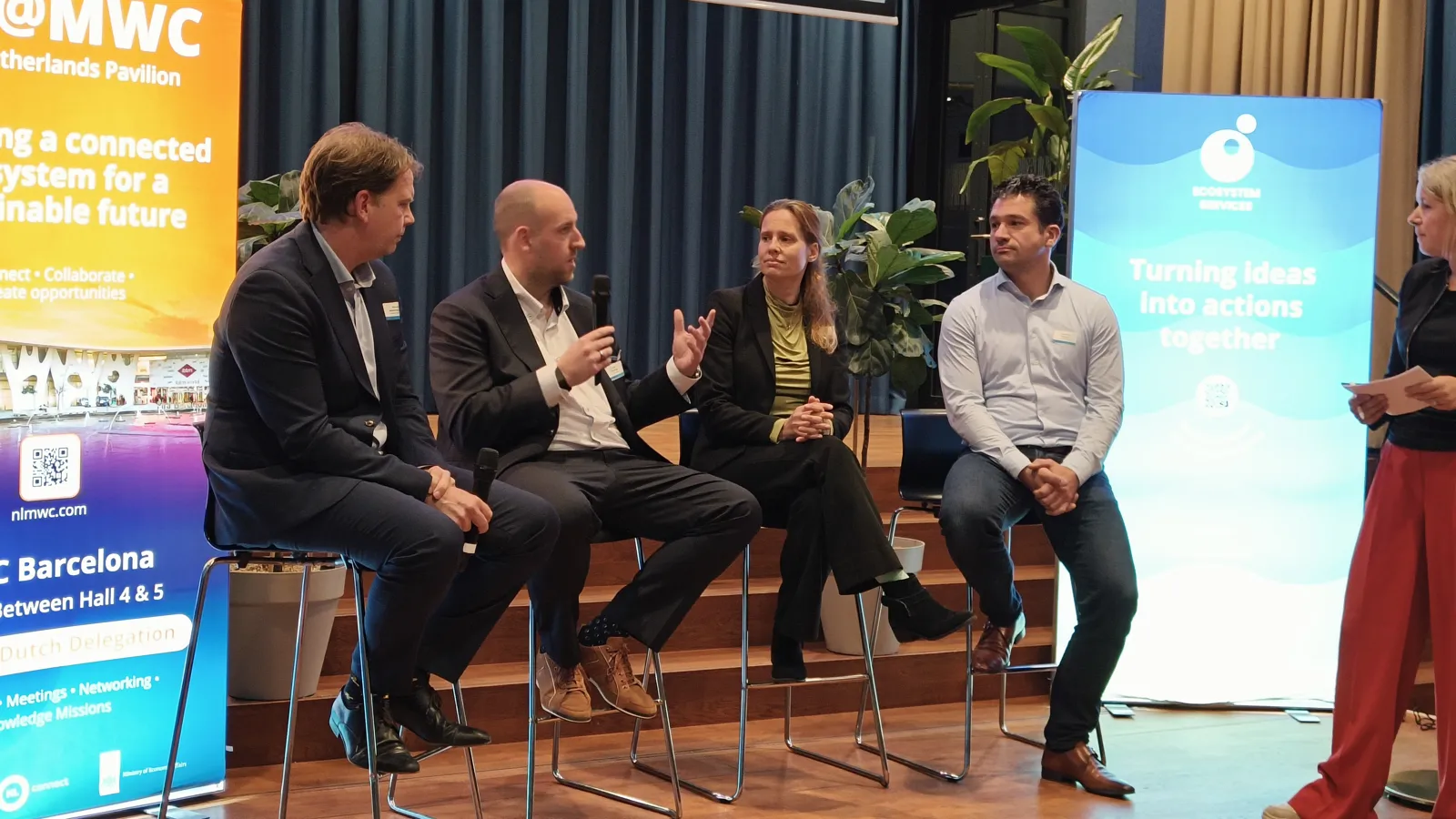
For the closing panel, Anke Kuipers invited Stephano Bosman, Ingrid Romijn, León Croese and Wouter Beijersbergen van Henegouwen to the stage. Her opening question: after a day full of vulnerabilities, why are we still so vulnerable?
Start by knowing yourself. Bosman sees several layers to the problem. It starts with self-assessment: not everything has to be as sovereign, or as public, as you might aim for. Identify your mission-critical workloads, map your dependencies across the supply chain, and accept that state actors are part of the landscape. With AI speeding everything up, organisations that used to be closed now need to open up to new partner ecosystems and “brace for impact”.
Awareness and speed. Romijn picked up the image of the donkey dancing on the ice: for years we didn’t realise how vulnerable we were, until US politics made it painfully clear. Europe does have the innovation, quantum security included, but innovators must prove themselves over and over. She contrasted this with Ukraine, where something new is tested straight away. Procurement adds another hurdle: multinationals are better at navigating tenders, and the rules make it hard to choose European.
No more trade-offs. Asked how he weighs cost, sustainability, resilience and compliance when building critical infrastructure such as the AI factory, Croese said the choice no longer exists: all factors have to come together, with far more disciplines around the table than before. On designing for threats we don’t fully understand yet, such as quantum, he warned that quantum security is of limited value if the fibre network itself is controlled by a US or Chinese party. Resilience requires control over the full stack.
The human factor. Bosman added that people tend to look to technology for resilience, while governance and behaviour are often the missing pieces. Romijn, on closing the knowledge gap: keep explaining and demonstrating, but above all build the networks and let organisations use them. Users will simply see a secured line; acceptance comes by doing.
Whole-of-society thinking. An audience member noted that, across scenarios ranging from cut subsea cables to payment-system failures, business continuity plans failed at the very first ripple effects, because they were designed for the enterprise rather than for society as a whole. Beijersbergen van Henegouwen agreed: long-term risks such as climate change cascade into everything else.
Who takes the lead? Should government, industry or both organise collective resilience? A mix, Croese suggested, and it starts with yourself: assess your own organisation, engage your partners and drive the conversation. Meanwhile, government already takes the lead for vital infrastructure through NIS2. An audience member pointed to the EU Critical Entities Resilience Directive, aligned with NIS2 and DORA, as a framework that is already there. The panel agreed much regulation exists, but noted the tension between regulating and leaving room to innovate when technology moves faster than legislation. Kuipers’ honest conclusion: there is no single answer yet, and we are exploring it together.
Asked for the one thing that should change in the next twelve months to make Europe’s digital infrastructure more resilient, the panel answered:
- Stephano Bosman: Think big, start small, prepare for scale.
- Ingrid Romijn: Be brave and start. Don’t stop at regulation and writing things down; act, even if the first step isn’t perfect.
- León Croese: Collaborate. Silos don’t solve this.
- Wouter Beijersbergen van Henegouwen: Stop treating resilience as a magic word. It takes time and effort, it might mean giving up some comfort, and it will sometimes hurt.
Next stop: on our way to NL@MWC Barcelona
The next NL@MWC community event is the Kick-off on 4 February 2027 at the Ministry of Economic Affairs in The Hague. Interested in joining the delegation or exhibiting? Visit nlmwc.com or contact the Ecosystem Services team.
And don’t forget to sign up and join the NL delegation to MWC Barcelona, or check the last options for partnering, exhibiting or meeting room space.
Thanks to the Municipality of The Hague for hosting, to all speakers, and to our media partner Telecompaper.